
Aug 7, 2026Technical Blog & Machining Tips
Is Your Carbide End Mill Vc Wasting Your Money?
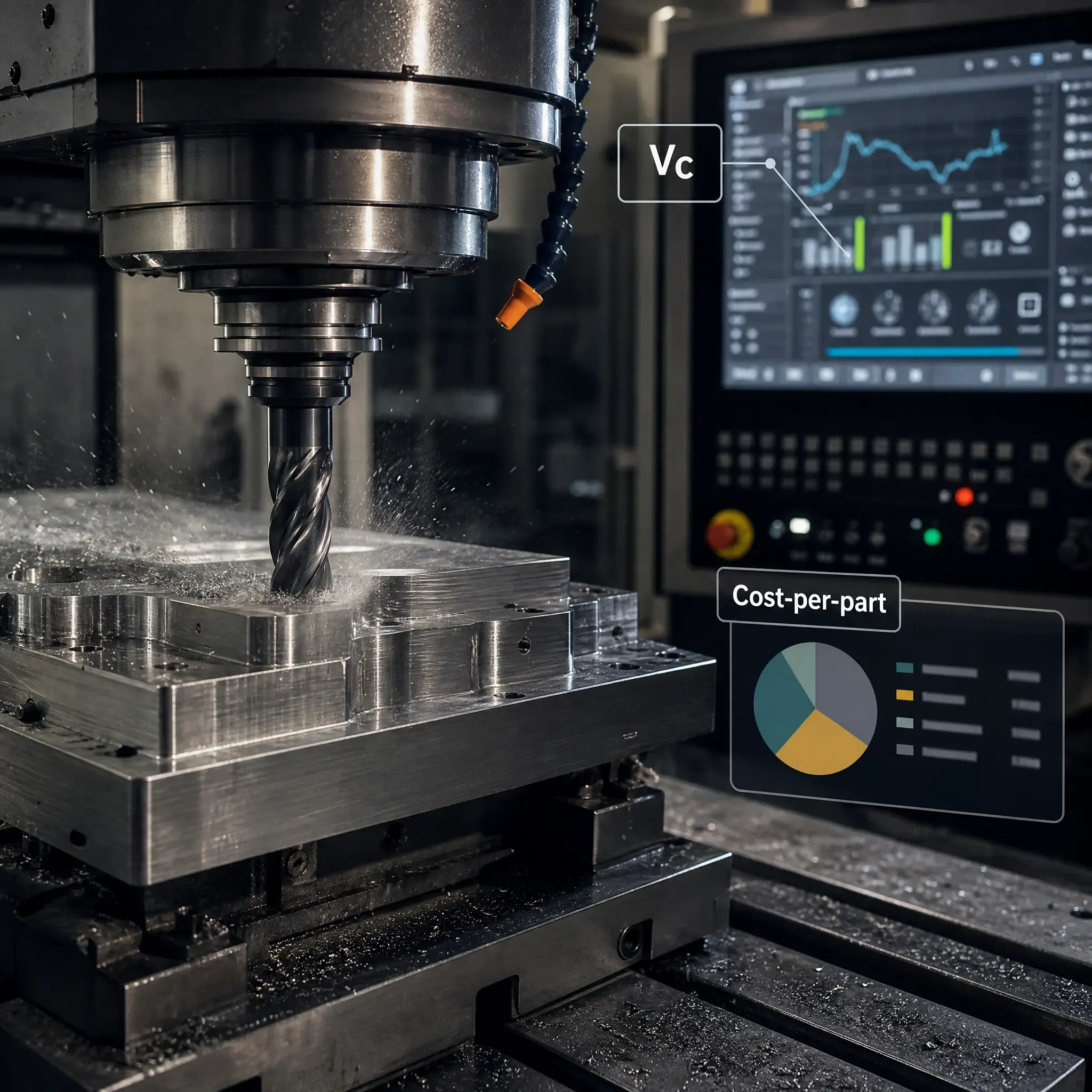
Focusing on the low unit price of a carbide end mill is a common but costly mistake. This narrow view often leads to frequent tool changes, poor performance, and hidden operational expenses that quietly erode your shop's profitability. The solution lies in understanding how the correct carbide end mill Vc (cutting speed) is the most powerful lever you have for reducing your true total machining cost.[1]
A carbide end mill's Vc, or cutting speed, is the primary economic lever that balances tool life against production speed. Choosing the wrong Vc makes a cheap tool expensive by either extending machine time or causing premature tool wear. Conversely, optimizing Vc for a quality tool maximizes its value, directly lowering your cost-per-part and boosting profitability.
Now that we've established Vc's critical role, let's move beyond the technical charts. It's time to reframe cutting speed not as a programming chore, but as a core business strategy. We will explore how to use it to drive efficiency and uncover the real cost drivers in your operations.
What is the 'Cost-per-Part' Framework for Machining?
You diligently track your tooling budget, but do you know how much each finished part truly costs to produce? Ignoring this crucial metric can hide significant inefficiencies, making it impossible to know if your procurement strategy is helping or hurting your bottom line.
The cost-per-part framework is an accounting model that calculates the total expense required to produce a single component.[2] It forces you to look beyond the tool's price tag and include the far more significant cost of the machine time used to make the part.
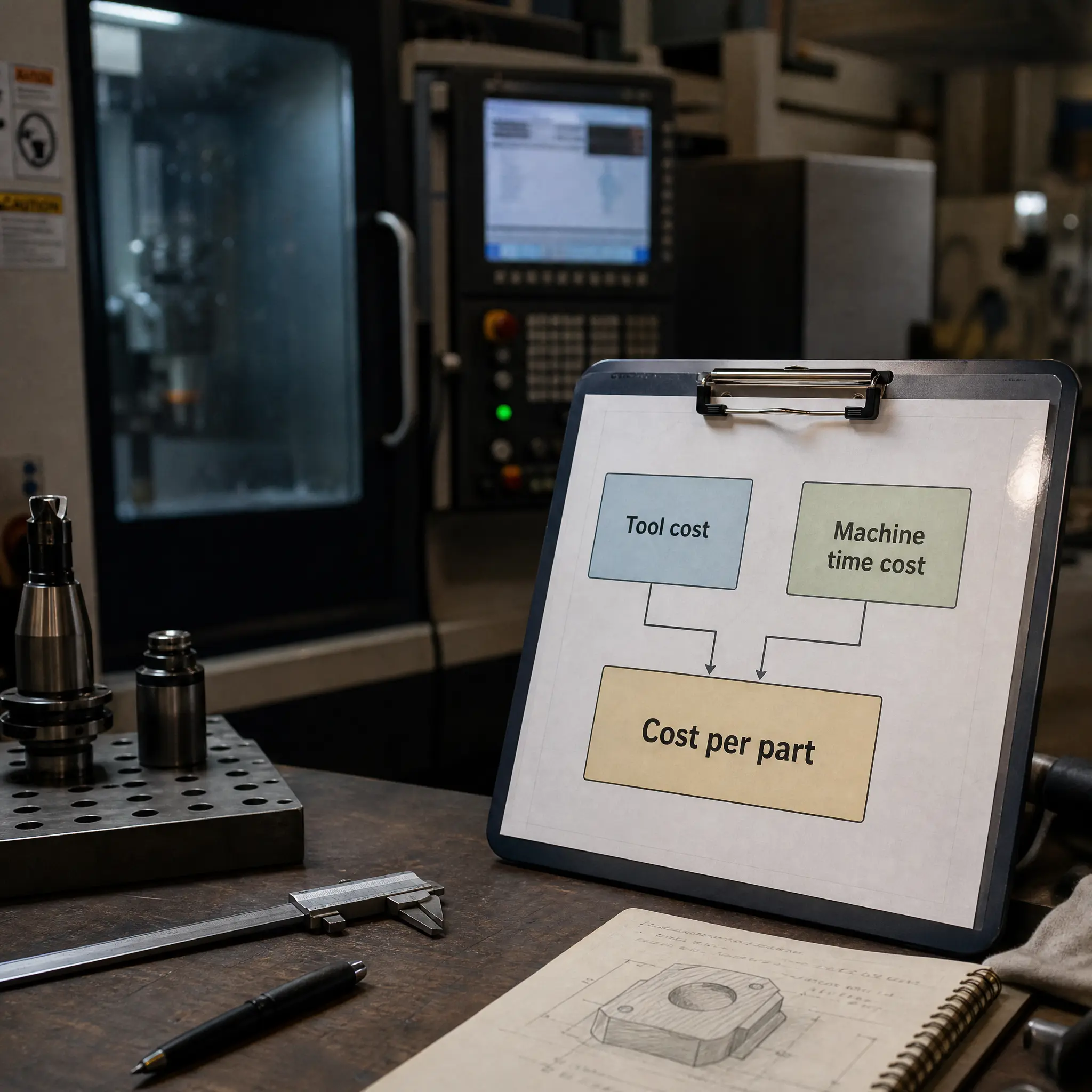
Dive Deeper: The Two Sides of the Cost Equation
For years, I've seen purchasing decisions hinge on a single number: the price on the invoice. But the most successful shops I work with focus on a different calculation entirely. They live and breathe the cost-per-part model. It’s simple, but it changes everything.
The formula looks like this:
Let's break down these two critical components.
H3: The Cost of Tool Consumption
This part of the equation,
(Tool Cost / Number of Parts per Tool), represents the direct tooling expense allocated to each workpiece you produce. It’s what most people think of when they consider tooling costs.- Example A: You buy a low-cost, generic end mill for **20 / 100 = $0.20 per part.
- Example B: You invest in a high-performance end mill for **50 / 500 = $0.10 per part.
In this isolated comparison, the tool that was 150% more expensive upfront is actually 50% cheaper on a per-part basis. This simple calculation alone reveals the flaw in focusing only on unit price. But this is only half the story. The real impact is revealed when we factor in machine time.
H3: The Dominant Cost of Machine Time
The second part of the formula,
(Machine Time Cost per Part), is where the biggest expenses hide. This is calculated as:(Cycle Time in Hours) x (Machine's Hourly Rate)The hourly rate of your CNC machine—including labor, overhead, power, and depreciation—is a massive and often underestimated expense.[4] A conservative estimate might be 125 per hour.[5] Every minute your spindle is running (or sitting idle during a tool change) has a significant cost attached to it.
If your machine rate is 90 / 6 = 3 per part. If you produce thousands of these parts, the savings become enormous. A myopic focus on saving $30 on a tool's price can easily cost you thousands in wasted machine time.
How Does Carbide End Mill Vc Control Your Total Cost?
You've probably seen cutting speed charts from tooling manufacturers, but do they feel like abstract, theoretical numbers? It's easy to feel like you're guessing, either running too slow and wasting time or running too fast and burning through expensive tools.
A carbide end mill Vc is the lever that dictates the trade-off between tool life (how many parts a tool can make) and material removal rate (how fast you make them).[6] As such, it directly controls both halves of the cost-per-part equation, making it an economic tool, not just a technical setting.

Dive Deeper: Finding the Economic Sweet Spot
I often use a simple analogy with clients: think of your Vc like the gears in a car. Your goal isn't just to make the engine last as long as possible or to get to your destination as fast as possible—it's to achieve the best overall efficiency.
H3: The 'Too Slow' Scenario: Driving in First Gear
When you run your carbide end mill Vc too low, you are prioritizing tool preservation above all else.
- What happens: Heat generation is minimal. The cutting edge experiences very little stress or thermal wear.[7] The tool seems to last forever. I've seen operators brag about getting thousands of parts from a single end mill by running it incredibly slowly.
- The business impact: While your
(Tool Cost / Parts per Tool)looks fantastic, your(Machine Time Cost per Part)is catastrophic. Your expensive CNC machine is operating at a fraction of its capability. You're paying a premium for that machine hour, but you're only getting a trickle of output. It's like buying a race car and never taking it out of the school zone. The money you "save" on tooling is dwarfed by the cost of lost production and wasted machine capacity.
H3: The 'Too Fast' Scenario: Redlining the Engine
On the other end of the spectrum, you can push the Vc to its absolute maximum, chasing the shortest possible cycle time.
- What happens: You are removing material at a blistering pace. However, the extreme speed generates immense heat at the cutting edge, far beyond what the tool was designed to handle.[8] The coating breaks down, the carbide substrate softens, and the tool fails prematurely through rapid flank wear, chipping, or catastrophic fracture.[9]
- The business impact: Your
(Machine Time Cost per Part)is low for the few parts you complete, but your(Tool Cost / Parts per Tool)skyrockets. Worse yet, you introduce massive hidden costs. Unpredictable tool failure leads to unplanned downtime, scrapped workpieces, and potential damage to the spindle or fixture. Your operators spend more time changing tools and touching off than they do producing parts.
H3: The 'Just Right' Economic Sweet Spot
This is where a high-quality tool proves its worth. A premium end mill isn't just "stronger"; it's engineered with specific carbide grades, advanced coatings, and optimized geometries to manage heat effectively at higher cutting speeds.[10]
This allows you to find the economic sweet spot: a carbide end mill Vc that is significantly faster than the "too slow" scenario but still provides predictable, reliable tool life. You achieve a major reduction in cycle time without introducing the chaos of constant tool changes. This sweet spot minimizes the total cost-per-part, delivering the highest profitability for the job.
What is the Real-World Impact of an Optimized Carbide End Mill Vc Strategy?
The theory sounds good, but does investing in a more expensive tool to run a faster carbide end mill Vc actually pay off? It's natural to be skeptical when a supplier tells you their premium tool will save you money in the long run. The proof is always in the numbers.
A strategic approach to Vc, paired with the right tool for the job, can dramatically lower your overall production costs. A common situation I encounter with new clients provides a perfect example of how a small increase in tool price can lead to a significant decrease in the final cost-per-part.

Dive Deeper: A Case Study in Profitability
Let me walk you through a situation with a client, a job shop making a large run of aluminum components. When I first visited, their primary focus was on minimizing their tooling spend.
H3: The "Before" Scenario: Fixated on Unit Price
- The Strategy: The shop owner was proud of sourcing a generic 1/2" carbide end mill for just $15 per tool.
- The Parameters: To protect their "low-cost" tool, they ran it at a very conservative Vc.
- The Results: Their cycle time for the main milling operation was 8 minutes. The tool would reliably last for about 200 parts before needing to be replaced.
- The Cost-per-Part Breakdown:
- Let's assume a conservative machine hourly rate of $75/hour.
- Machine Time Cost: (8 min / 60) * 10.00 per part**
- Tool Consumption Cost: 0.075 per part**
- Total Cost-per-Part: $10.075
H3: The "After" Scenario: Focusing on Total Cost
After reviewing their process, I suggested they test one of our high-performance end mills specifically designed for non-ferrous materials. The price was $35, a more than 130% increase that initially made the owner very hesitant.
- The Strategy: We would leverage the tool's advanced coating and geometry to run a much more aggressive carbide end mill Vc.
- The Parameters: We increased the cutting speed and feed rate based on our established recommendations for that tool in 6061 aluminum.
- The Results: The new cycle time was just 5 minutes—a 37.5% reduction. Because the tool was engineered to handle the thermal load, it maintained excellent edge integrity and had a predictable life of 700 parts.
- The Cost-per-Part Breakdown:
- Machine Time Cost: (5 min / 60) * 6.25 per part**
- Tool Consumption Cost: 0.05 per part**
- Total Cost-per-Part: $6.30
The shop owner was initially focused on the 3.77 savings per part translated directly into tens of thousands of dollars in pure profit over the life of the project.
What Questions Should You Ask a Supplier About Their Tooling?
You're ready to look beyond the price tag and adopt a total-cost mindset. But how do you effectively evaluate a supplier's claims and cut through the marketing jargon? Asking the right questions transforms you from a price-shopper into a strategic partner, and it helps you separate a true consultant from a simple parts vendor.
To determine a tool's real value, you must ask suppliers for application-specific data, clear starting parameter recommendations, and evidence of the support they provide to help you calculate and optimize your total cost-per-part.
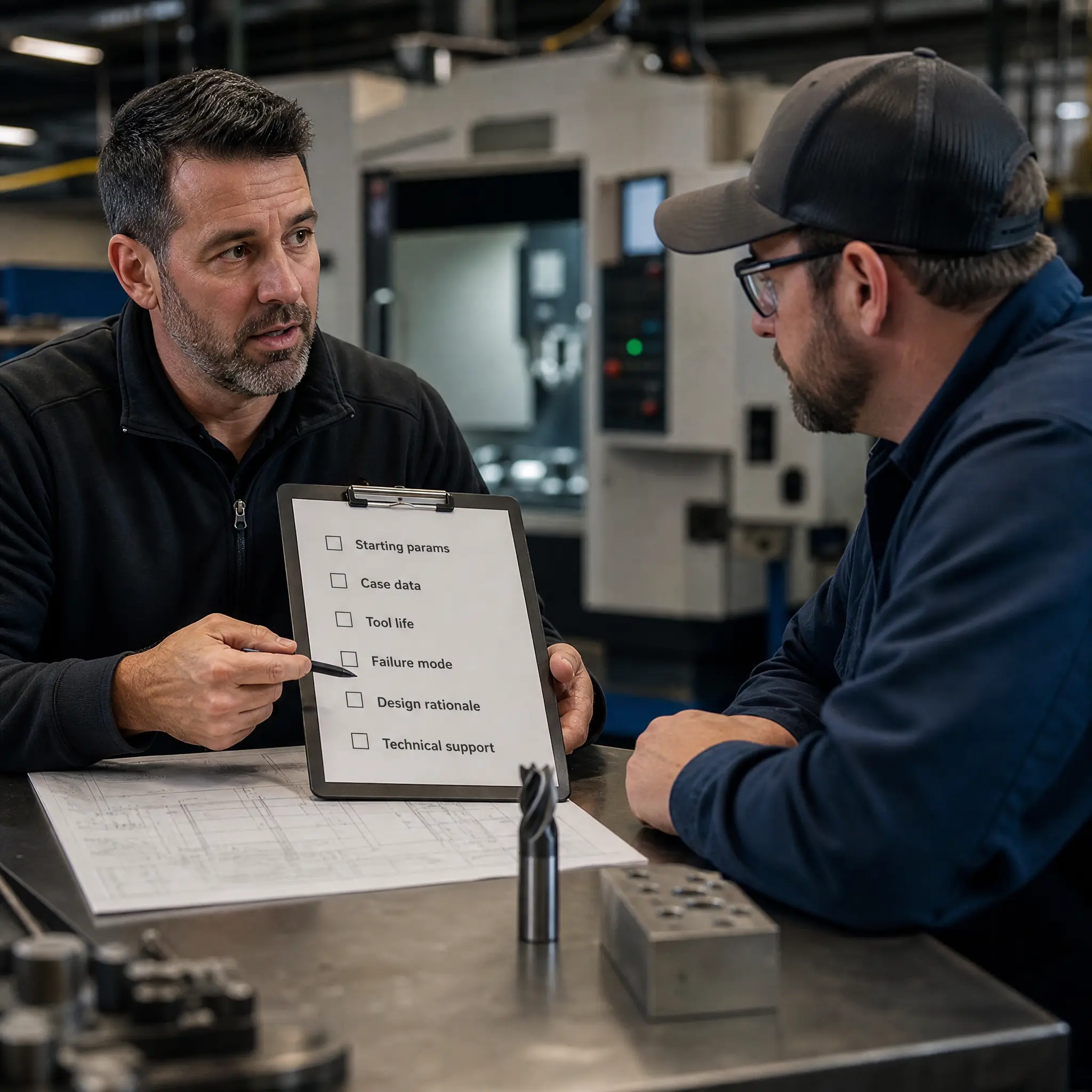
Dive Deeper: A Checklist for Evaluating Tooling Partners
As part of my role at QT TOOLS, I spend most of my time helping customers answer these very questions. A good supplier should welcome this conversation. Use this checklist to guide your next discussion about tooling procurement.
H3: Checklist for Smart Tooling Evaluation
- "What are your recommended starting parameters (Vc, feed rate, stepover) for this tool in my specific material and application?" A true partner won't just point you to a generic chart. They will ask clarifying questions about your material (e.g., "Is it 304 or 316 stainless?"), your machine's horsepower and taper, and your workholding rigidity. Their answer should be a confident starting point, not a vague range.
- "Can you provide a case study or performance data for this tool in a similar application?" They should be able to back up claims of "higher performance" with real numbers. Ask for data on cycle time reduction, tool life improvement, or both. This demonstrates they track performance and understand the economic value their tools provide.
- "What is the expected tool life at these recommended parameters, and what is the typical failure mode?" This two-part question is crucial. The first part helps you model your cost-per-part. The second part tells you if they truly understand their product. A good answer sounds like, "You should expect predictable flank wear after about 4 hours in the cut. If you see chipping before that, we should look at your feed rate." This shows they know the tool's limits and are prepared to help you troubleshoot.
- "How does this tool's specific design (geometry, coating, carbide grade) justify its price and enable better performance?" This question forces the supplier to explain their value proposition beyond buzzwords. "It has a special coating" is a weak answer. "Our AlCrN-based coating has high hot hardness, allowing it to maintain its integrity at the higher thermal loads[11] generated by the recommended carbide end mill Vc in hardened steels" is a valuable, expert answer.
- "What level of technical support do you provide to help us optimize our process and validate these results?" This is the ultimate question that separates a vendor from a partner. A vendor ships a box. A partner, like our team at QT TOOLS, works with you to ensure you achieve the promised results. Their willingness to invest time in your success is the clearest indicator of the true value they offer.
Frequently Asked Questions
What is Vc in milling?
Vc, or cutting speed, is the surface speed at which the cutting edge of the tool moves across the workpiece.[12] It's typically measured in meters per minute (m/min) or surface feet per minute (SFM). It is a critical factor influencing heat generation, tool wear, material removal rate, and surface finish.
How do I calculate RPM from Vc?
The formula to convert Vc to spindle speed (RPM) is: RPM = (Vc * 1000) / (π * D), where Vc is in m/min and D (tool diameter) is in mm. For imperial units, the formula is: RPM = (SFM * 3.82) / D, where D is in inches. Most modern CAM systems and controllers handle this conversion automatically.
Does a higher Vc always mean faster machining?
Not necessarily in terms of total throughput. A higher Vc increases the material removal rate and shortens the in-cut cycle time. However, if that speed drastically reduces tool life, the cumulative time spent on frequent tool changes and machine downtime can easily negate any cycle time savings, resulting in lower overall output.
Why is a more expensive carbide end mill sometimes cheaper to run?
A premium end mill uses superior raw materials, advanced PVD coatings, and highly engineered geometries. This combination allows it to effectively manage heat and stress at higher cutting speeds. This enables you to run at a more efficient Vc, reducing expensive machine time and improving tool life, which lowers the total cost-per-part far more than the initial price difference.
Conclusion
The unit price of an end mill is one of the most misleading metrics in a machine shop. The true measure of a tool's value is its impact on your total cost-per-part. By understanding that your carbide end mill Vc is an economic lever, not just a technical input, you can shift your focus from saving pennies on procurement to generating dollars in efficiency. Optimizing your cutting parameters with a quality tool designed for the task is a direct path to reducing cycle times, increasing throughput, and boosting your bottom line. Viewing your carbide end mill Vc as a business strategy is the first step toward unlocking a powerful competitive advantage.
At QT TOOLS, we are committed to partnering with our customers to deliver not just tools, but profitability. If you're ready to look beyond the price tag and start reducing your true cost-per-part, contact our team today. We are here to provide the products and assistance you need to gain the edge in a competitive market.
1
"U.S. Bureau of Economic Analysis (BEA)", https://www.bea.gov/. Machining-economics literature treats cutting speed as a central decision variable because it simultaneously affects tool life and machining time, which together determine unit production cost. Evidence role: general_support; source type: paper. Supports: Machining economics studies model cutting speed as a key variable linking tool life, production time, and minimum unit cost.. Scope note: The source would support the general economic mechanism, not prove that Vc is always the single most powerful lever in every shop.
2
"(PDF) Manufacturing cost modelling for concurrent product ...", https://www.academia.edu/17047007/Manufacturing_cost_modelling_for_concurrent_product_development. Manufacturing cost-accounting references define unit cost as the allocation of production expenses to an individual output item, commonly including materials, tooling, labor, machine time, and overhead. Evidence role: definition; source type: education. Supports: Manufacturing cost models calculate unit cost by allocating direct and indirect production costs to each part.. Scope note: The source would substantiate the accounting concept rather than the article's specific simplified formula.
3
"An Approach to Cost Estimation of Mould Manufacturing ...", https://ui.adsabs.harvard.edu/abs/2007isam.conf...22S/abstract. Published machining-cost models commonly express unit production cost as a combination of machining-time cost and tool-related cost allocated over the number of parts produced per tool. Evidence role: general_support; source type: paper. Supports: Machining cost models commonly include tooling cost per workpiece and machining time cost as components of unit production cost.. Scope note: The source would support the structure of the simplified equation, while real industrial costing may also include setup, inspection, scrap, coolant, and administrative overhead.
4
"Departmental Machine-Hour Rates in a Small Company", https://egrove.olemiss.edu/cgi/viewcontent.cgi?article=1086&context=mgmtservices. Manufacturing cost-accounting sources describe machine-hour rates as composite rates that may include operator labor, overhead allocation, energy consumption, maintenance, and equipment depreciation. Evidence role: general_support; source type: education. Supports: Machine-hour costing allocates labor, overhead, power or energy, and depreciation to machine operating time.. Scope note: The source would support the cost categories, not the article's qualitative statement that the expense is often underestimated.
5
"Machinists", https://www.bls.gov/oes/2023/may/oes514041.htm. Machining cost-estimation references report that CNC machine-hour rates can reach tens to more than one hundred dollars per hour once labor, overhead, and equipment costs are included. Evidence role: statistic; source type: other. Supports: Published machining-cost references or surveys report CNC shop or machine-hour rates broadly comparable to the article's illustrative range.. Scope note: The cited range would be contextual rather than universal, because actual machine-hour rates depend strongly on geography, machine type, utilization, and accounting assumptions.
6
"Logistic classification for tool life modeling in machining", https://mtrc.utk.edu/wp-content/uploads/sites/45/2024/10/logistic-classification-tool-life.pdf. Machining theory, including Taylor's tool-life relationship, identifies cutting speed as a principal variable affecting tool life, while higher cutting speeds also increase the rate at which the tool traverses the workpiece surface. Evidence role: mechanism; source type: education. Supports: Cutting speed is inversely related to tool life in standard tool-life models and directly affects production rate.. Scope note: The source would support the general relationship; the exact trade-off depends on workpiece material, tool material, coating, feed, depth of cut, coolant, and machine rigidity.
7
"Cutting conditions and tool wear when machining wood ...", https://bioresources.cnr.ncsu.edu/resources/cutting-conditions-and-tool-wear-when-machining-wood-based-materials/. Experimental and theoretical machining studies show that cutting speed is a major determinant of cutting temperature, with lower speeds generally reducing thermal loading and temperature-related wear mechanisms at the cutting edge. Evidence role: mechanism; source type: paper. Supports: Cutting temperature and thermally driven tool wear generally increase as cutting speed rises, making lower speeds less thermally severe.. Scope note: The source would support the general thermal trend, not guarantee minimal heat or wear under every low-speed machining condition.
8
"Temperature and wear of cutting tools in high-speed machining of Inconel ...", https://www.sciencedirect.com/science/article/pii/S0043164896072559. Machining research reports that increasing cutting speed can substantially increase cutting-zone temperature, which accelerates thermally activated wear mechanisms in carbide cutting tools. Evidence role: mechanism; source type: paper. Supports: High cutting speeds can raise cutting-edge temperatures and accelerate wear or failure of carbide tools.. Scope note: The source would support the mechanism, while the phrase 'beyond what the tool was designed to handle' depends on the specific tool grade, coating, coolant condition, and application.
9
"(PDF) Wear mechanisms of cutting tools in high-speed ...", https://www.academia.edu/99880636/Wear_mechanisms_of_cutting_tools_in_high_speed_cutting_processes. Studies of coated carbide cutting tools identify flank wear, edge chipping, coating degradation, and fracture as common failure modes, particularly when thermal and mechanical loads exceed the tool's operating window. Evidence role: mechanism; source type: paper. Supports: Carbide cutting tools can fail through flank wear, chipping, fracture, and coating degradation under severe machining conditions.. Scope note: The source would support the listed failure modes generally, not diagnose the failure of any particular end mill in the article.
10
"Engineered design of cutting tool material, geometry, and coating for ...", https://www.sciencedirect.com/science/article/pii/S1755581724000798. Cutting-tool research shows that carbide substrate properties, coating systems, and edge geometry influence heat resistance, chip formation, friction, and wear behavior during high-speed machining. Evidence role: mechanism; source type: paper. Supports: Tool material, coating composition, and geometry affect heat resistance, wear behavior, and allowable cutting conditions.. Scope note: The source would support the design principles, not establish the superiority of any named commercial tool.
11
"Characterization and Evaluation of Engineered Coating ... - PMC", https://pmc.ncbi.nlm.nih.gov/articles/PMC9415707/. Materials studies of AlCrN-based PVD coatings report high-temperature hardness and oxidation resistance, properties associated with improved coating stability under the thermal loads of metal cutting. Evidence role: mechanism; source type: paper. Supports: AlCrN coatings are reported to have high-temperature hardness, oxidation resistance, or thermal stability relevant to cutting-tool applications.. Scope note: The source would support the coating-property claim generally; actual tool performance still depends on coating architecture, substrate, edge preparation, and cutting conditions.
12
"cutting forces by peripheral cutting of low density wood ...", https://bioresources.cnr.ncsu.edu/BioRes_02/BioRes_02_4_671_681_Pornkiewicz_BT_CuttingForces_Peripheral_LowDenWood.pdf. Standard machining references define cutting speed as the relative surface speed at which the cutting edge engages the workpiece, commonly expressed in metres per minute or surface feet per minute. Evidence role: definition; source type: encyclopedia. Supports: Cutting speed is defined as the surface speed between the cutting tool and the workpiece..