
Aug 12, 2026Technical Blog & Machining Tips
High-Performance Solid Carbide End Mills: Are They Worth the Higher Price?
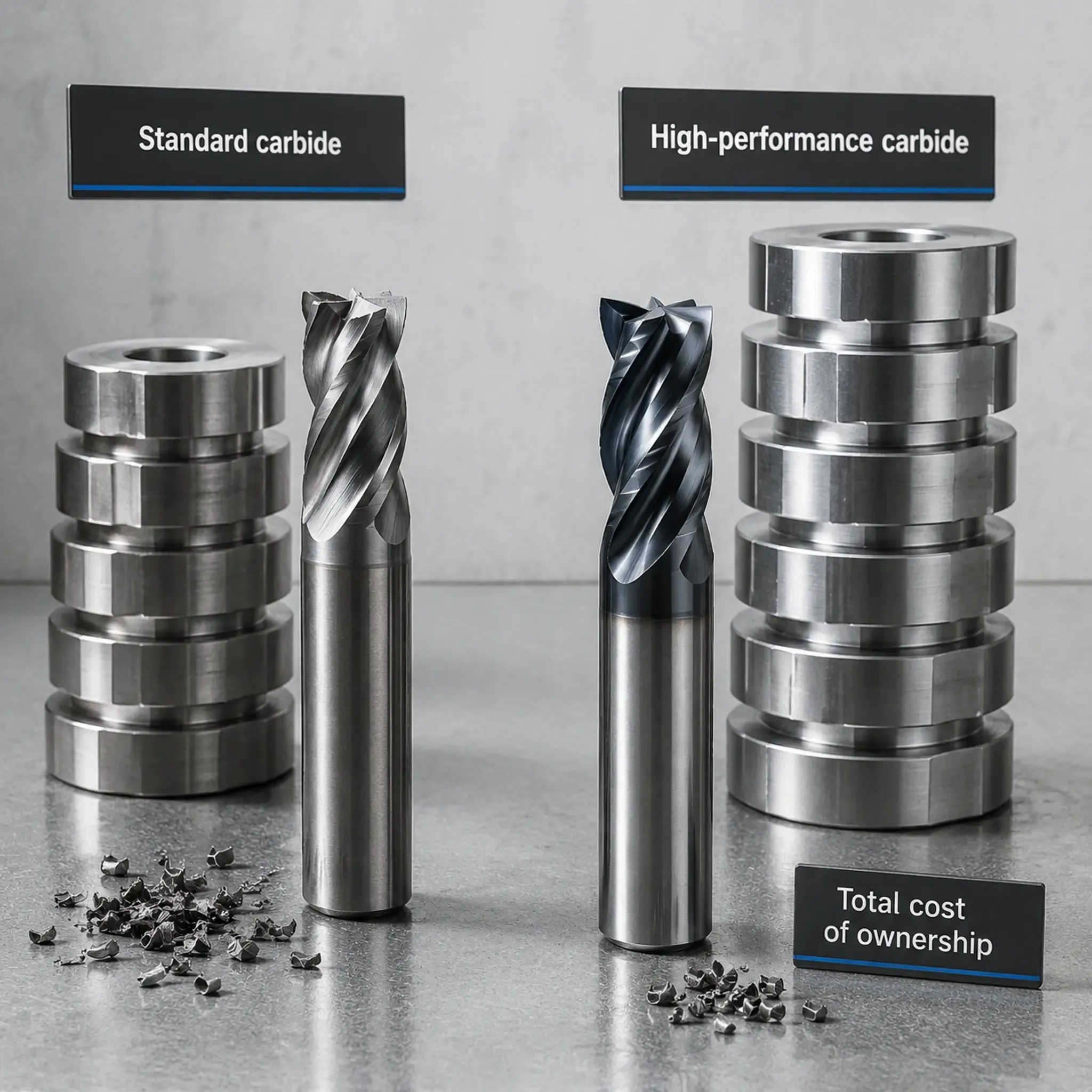
High-Performance Solid Carbide End Mills often look expensive when a buyer compares only the unit price. That narrow view creates pressure to choose cheaper tools, but it can also hide higher scrap, slower cycle times, and more stoppages. I use a total cost approach to decide when premium tooling improves real factory profitability.
High-performance solid carbide end mills are worth the higher price when they reduce cost-per-part through longer tool life, faster cycle time, better chip control, and fewer machine interruptions. The right tool is not always the lowest-priced tool; it is the tool that delivers stable output, predictable quality, and higher throughput in the actual machining process.
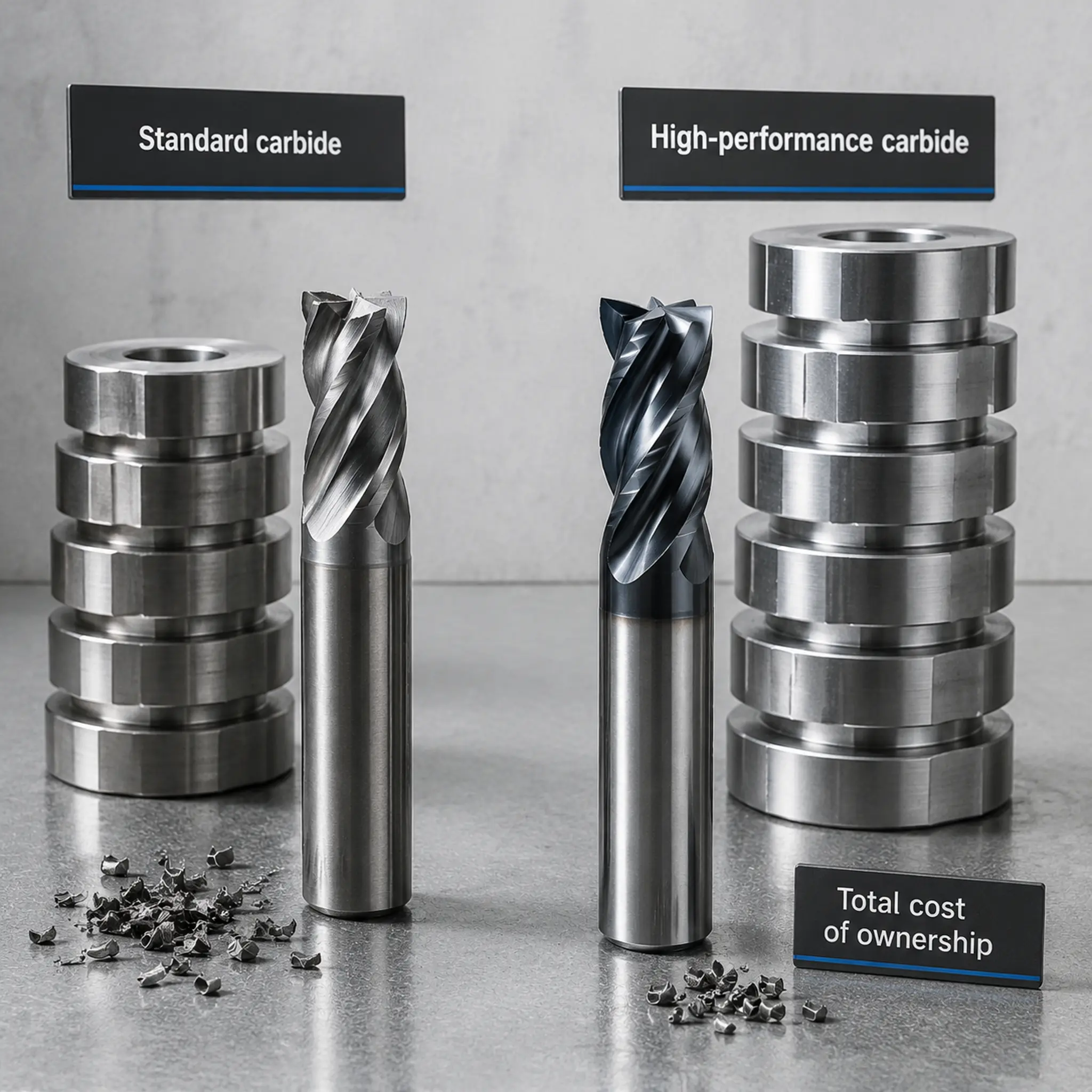
The key question is not, “How much does this cutter cost?” The better question is, “What does this cutter do to my total manufacturing cost?” I have seen many procurement discussions change direction once the team compares tool price with uptime, scrap rate, and parts-per-shift.
How Do High-Performance Solid Carbide End Mills Reduce Total Cost of Ownership?
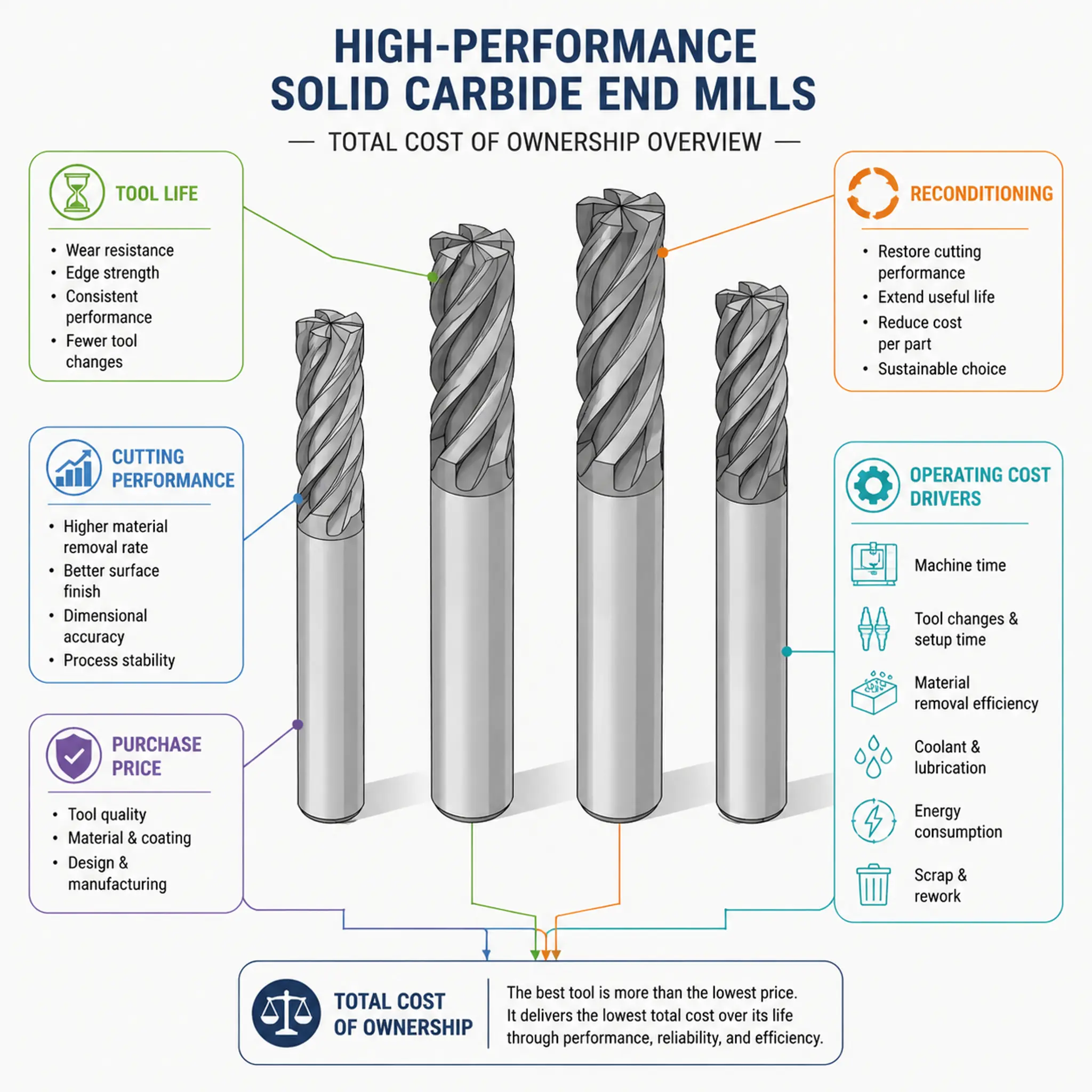
A cheap cutter can look attractive during purchasing, especially when budgets are tight. The problem appears later on the production floor. Operators change tools more often, machines wait longer, and part quality becomes less predictable. High-Performance Solid Carbide End Mills should be evaluated through total cost of ownership, not purchase price alone[1].
High-performance solid carbide end mills reduce total cost of ownership when they increase tool life, shorten cycle time, reduce downtime, and lower scrap. A higher unit price can still create a lower cost-per-part if the tool produces more qualified components per shift with fewer interventions and more stable process control.
The “unit price trap” in tooling procurement
I often see buyers compare end mills in a simple way:
“Supplier A offers one cutter at42. Supplier A is cheaper.”
That comparison is easy, but it is incomplete. A cutting tool is not only a purchased item. It is a production variable. It affects the machine, the operator, the fixture, the part, the inspection process, and the delivery schedule.
When I analyze production data with clients, I usually break tooling cost into four practical areas:
- Tool life How many qualified parts does one end mill produce before replacement?
- Cycle time How many seconds or minutes does the tool save per part?
- Machine downtime How often does the operator stop the spindle for tool changes, adjustments, or inspection?
- Scrap and rework rate How many parts fail due to burrs, dimensional drift, chatter marks, or poor surface finish?
The unit price is only one line in the calculation. In high-volume machining, the machine hour cost usually matters more[2].
A simple TCO comparison
The table below shows a simplified example. The numbers are representative of the kind of analysis I use in customer discussions. They should always be validated through a controlled trial in the buyer’s own application.
Metric | Standard Carbide End Mill | High-Performance Solid Carbide End Mill |
|---|---|---|
Tool price | $18 | $42 |
Tool life | 180 parts | 720 parts |
Tool cost per part | $0.10 | $0.058 |
Cycle time | 92 seconds | 71 seconds |
Machine cost | $60/hour | $60/hour |
Machine cost per part | $1.53 | $1.18 |
Estimated total per part | $1.63 | $1.24 |
In this example, the higher-priced cutter lowers the estimated cost by 19,500 before considering reduced scrap and fewer operator interventions.
Why tool life alone is not enough
Many suppliers focus only on tool life. I think that is too narrow. A cutter that lasts longer but runs slowly may not improve profitability. A tool that runs fast but fails unpredictably can damage delivery reliability. A useful evaluation should ask:
- Does the tool hold size across the batch?
- Does the surface finish remain stable near the end of tool life?
- Does chip evacuation remain reliable?
- Does the machine load stay within a safe range?
- Does the operator need fewer offsets and manual checks?
For procurement teams, this framework shifts the conversation from price to process economics. That shift is important because a factory does not earn profit by buying cheap tools. A factory earns profit by producing qualified parts at the lowest reliable cost.
Why Do High-Performance Solid Carbide End Mills Matter in Difficult Materials?
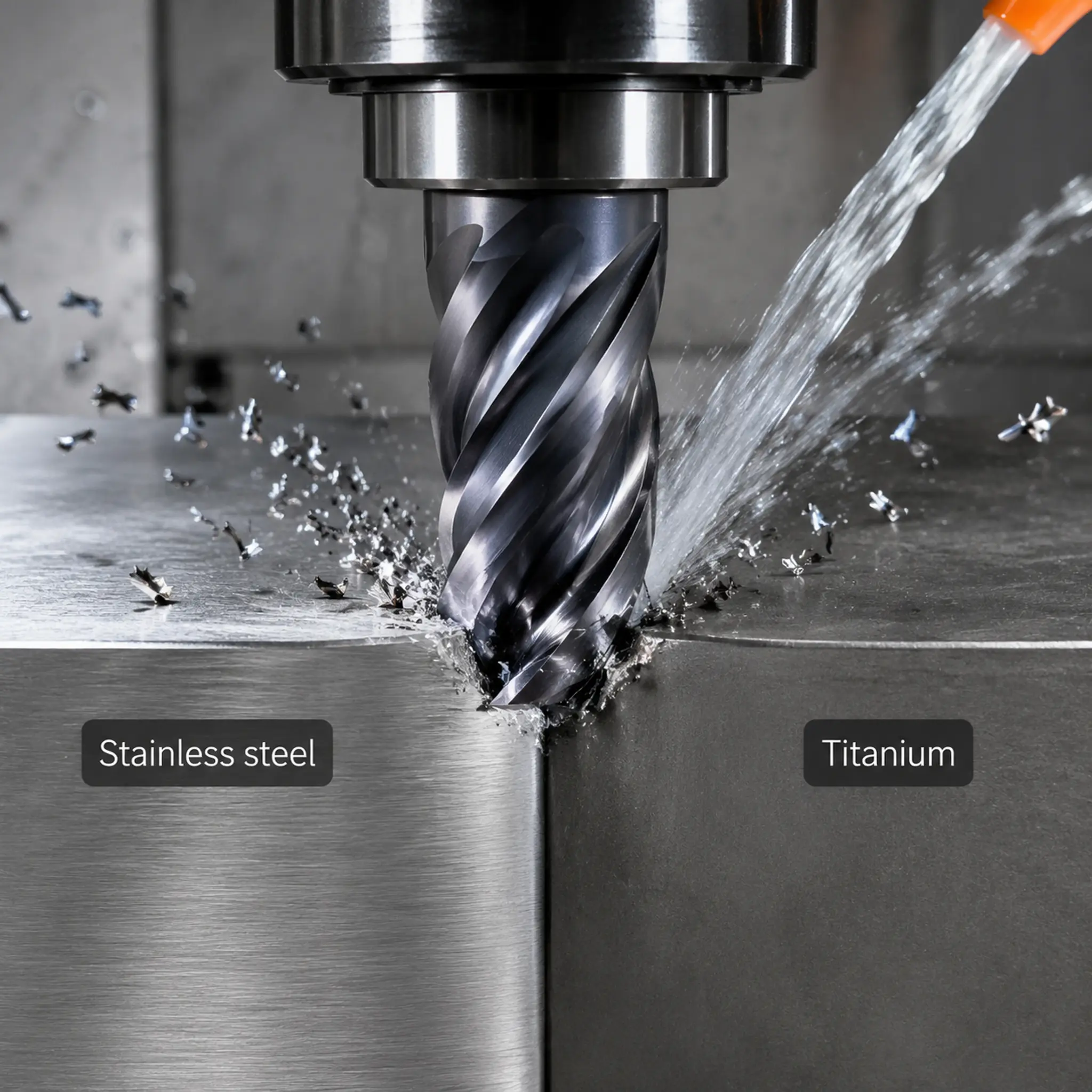
Difficult materials create problems that a generic tool cannot always solve. Stainless steel work-hardens. Titanium holds heat near the cutting edge. Hardened steels punish weak geometries. If the tool design does not match the material behavior, the factory may face chatter, heat damage, poor finish, and sudden tool failure.
High-performance solid carbide end mills matter in difficult materials because their geometry, carbide grade, coating, and edge preparation are designed to control heat, chips, vibration, and wear. Their value comes from process know-how, not from the carbide alone. The best result still requires correct parameters, coolant strategy, and machine stability.
Performance is embedded in the design
From my experience with clients in automotive, aerospace, and medical component machining, difficult materials expose the weakness of generic tooling very quickly. The cutter does not fail only because the carbide is “bad.” It often fails because the design does not match the cutting condition.
A high-performance cutter usually combines several design choices:
Design Feature | Factory-Floor Impact | Business Result |
|---|---|---|
Reduces chatter and vibration | Better surface finish and fewer rejected parts | |
Improves chip evacuation | Fewer chip jams and less operator intervention | |
Strong core diameter | Improves rigidity | More stable cutting in deep slots or heavy side milling |
Prevents early micro-chipping | More predictable tool life | |
Controls heat and wear | Higher cutting speed and longer production runs |
The important point is not the specification by itself. The value appears when the specification solves a production problem.
Stainless steel example
Stainless steel can work-harden if the cutter rubs instead of cuts.[7] If the edge is too weak, it chips. If the geometry does not evacuate chips properly, heat rises and the finish becomes unstable.
In this case, a suitable high-performance solid carbide end mill may help by:
- Maintaining a sharper, stronger cutting edge
- Reducing rubbing through proper rake and relief design
- Moving chips out of the cutting zone more efficiently
- Supporting higher feed rates without unstable vibration
The business result is not just “better cutting.” The business result is more predictable parts-per-shift.
Titanium alloy example
Titanium machining has a different challenge. Heat does not leave the cutting zone easily.[8] The cutting edge carries more thermal stress. Poor tool design can lead to notch wear, built-up edge, and sudden failure[9].
For titanium, I usually pay close attention to:
- Tool coating suitability The coating must support heat and wear resistance without causing chip adhesion problems.
- Chip thickness control The feed strategy should avoid rubbing and avoid excessive edge load.
- Coolant delivery Coolant pressure and direction can change tool life dramatically.
- Radial engagement Trochoidal or high-efficiency milling strategies may reduce heat concentration.[10]
No tool is a magic bullet. A premium cutter used with poor parameters can still fail. That is why I prefer to evaluate tooling as a system: machine, holder, runout, coolant, material batch, fixture, and cutting data.
What buyers should verify
Before approving a premium cutter for difficult materials, I suggest that buyers request or define:
- Workpiece material grade and hardness
- Cutting diameter, flute count, and flute length
- Operation type: slotting, profiling, pocketing, finishing, or roughing
- Machine spindle power and maximum RPM
- Toolholder type and runout measurement
- Coolant type, pressure, and delivery method
- Target part quality requirements
- Trial success metrics
For technical purchasing, this is where supplier selection becomes important. A supplier should not only quote a price. A supplier should help interpret the process and propose a tool that matches the application. At QT TOOLS, I treat that discussion as part of the product value because the wrong cutter in the wrong process rarely produces a fair result.
What Production Data Proves High-Performance Solid Carbide End Mills Can Lower Cost Per Part?
A production manager does not need vague promises. The manager needs proof from the machine. Without data, a premium tool looks risky. With controlled production data, the decision becomes clearer. High-Performance Solid Carbide End Mills should be tested against measurable targets such as cycle time, tool life, scrap, and machine uptime.
Production data proves value when a premium end mill lowers the actual cost-per-part, not just the tool cost. In one controlled customer-style evaluation, the stronger tool reduced cycle time, increased tool life, and improved parts-per-shift. The higher purchase price was justified because the factory produced more qualified parts with fewer interruptions.
An anonymized customer-style case from mass production
I will describe a realistic, anonymized example based on the type of production analysis I review with customers. The part was a stainless steel component used in a high-volume assembly line. The operation involved side milling and finishing features where surface consistency and dimensional control mattered.
The factory had three main concerns:
- The existing tool wore out before the planned tool-change interval.
- Operators adjusted offsets several times per shift.
- Cycle time was limiting output during peak order periods.
The team wanted to know whether a higher-priced cutter could reduce the total cost. We agreed that the trial should not be judged by tool price alone. It would be judged by production metrics.
Trial setup
Item | Trial Detail |
|---|---|
Material | 304 stainless steel |
Operation | Side milling and finishing |
Machine type | Vertical machining center |
Tool diameter | 10 mm |
Comparison | Standard carbide end mill vs. premium design |
Measurement period | Multiple tool lives under similar conditions |
Key metrics | Tool life, cycle time, surface finish, downtime |
The premium cutter used a geometry designed for stainless steel machining. The exact details depended on the application, but the main goals were clear: reduce chatter, improve chip control, and maintain edge stability.
Results from the evaluation
Metric | Existing Tool | Premium Tool | Change |
|---|---|---|---|
Average tool life | 210 parts | 680 parts | +224% |
Cycle time per part | 84 seconds | 67 seconds | -20.2% |
Tool changes per 10,000 parts | 48 | 15 | -68.8% |
Scrap/rework rate linked to finish | 1.8% | 0.6% | -66.7% |
Parts per 8-hour shift | 342 parts | 430 parts | +25.7% |
These numbers changed the purchasing discussion. The premium cutter cost more per piece, but it produced more parts per tool and more parts per shift. The team also spent less time managing tool changes and finish-related adjustments.
Translating results into money
Let us use a simplified calculation.
Assume:
- Machine cost: $60 per hour
- Existing cycle time: 84 seconds
- Premium cycle time: 67 seconds
- Time saved: 17 seconds per part
That time saving equals 4.72 hours per 1,000 parts.
At $60 per hour, the machine time saving is:
4.72 × 283.20 per 1,000 parts
That is before tool-change savings and scrap reduction. If the factory produces 30,000 parts per month, cycle time alone represents about:
$8,496 per month in machine-time value
This kind of number is why I say premium tooling should be discussed as a profitability lever. The tool price matters, but it is not the main number in a high-volume process.
What made the improvement possible?
The improvement did not come from one feature alone. It came from the combination of tool design and application fit.
The main contributors were:
- More stable cutting edge The edge resisted micro-chipping, which helped maintain finish quality longer.
- Better vibration control The geometry reduced chatter, so the process could run at a higher feed with less risk.
- Improved chip evacuation Chips left the cutting zone more reliably, which reduced recutting and heat buildup.
- More predictable wear pattern Operators could plan tool changes instead of reacting to sudden failure.
I always remind customers that a trial should be documented carefully. If the machine, holder, material batch, or coolant condition changes too much, the data becomes less useful. A fair trial protects both the buyer and the supplier.
How Should Procurement Teams Evaluate High-Performance Solid Carbide End Mills?
Procurement teams often face pressure from both sides. Finance wants lower purchase prices. Production wants stable output. Engineering wants process capability. If the evaluation method focuses only on quotes, the team may reject a tool that would save money in production. A structured trial gives everyone better evidence.
Procurement teams should evaluate high-performance solid carbide end mills by defining success metrics before the trial, comparing total cost per part, checking supplier capability, and verifying quality documentation. The best purchasing decision combines price, tool performance, delivery reliability, technical support, and the supplier’s ability to support repeatable production.
Step 1: Define the machining problem
Before asking for a quotation, I suggest defining the production pain point. A vague request like “quote 10 mm end mill” does not give the supplier enough information. A better request explains the goal.
For example:
- “We need to reduce cycle time in 316 stainless steel finishing.”
- “We need longer tool life in titanium pocketing.”
- “We need better surface finish stability across a full shift.”
- “We need fewer tool changes in automated production.”
This helps the supplier recommend a tool based on the operation, not only the diameter.
Step 2: Build a fair comparison table
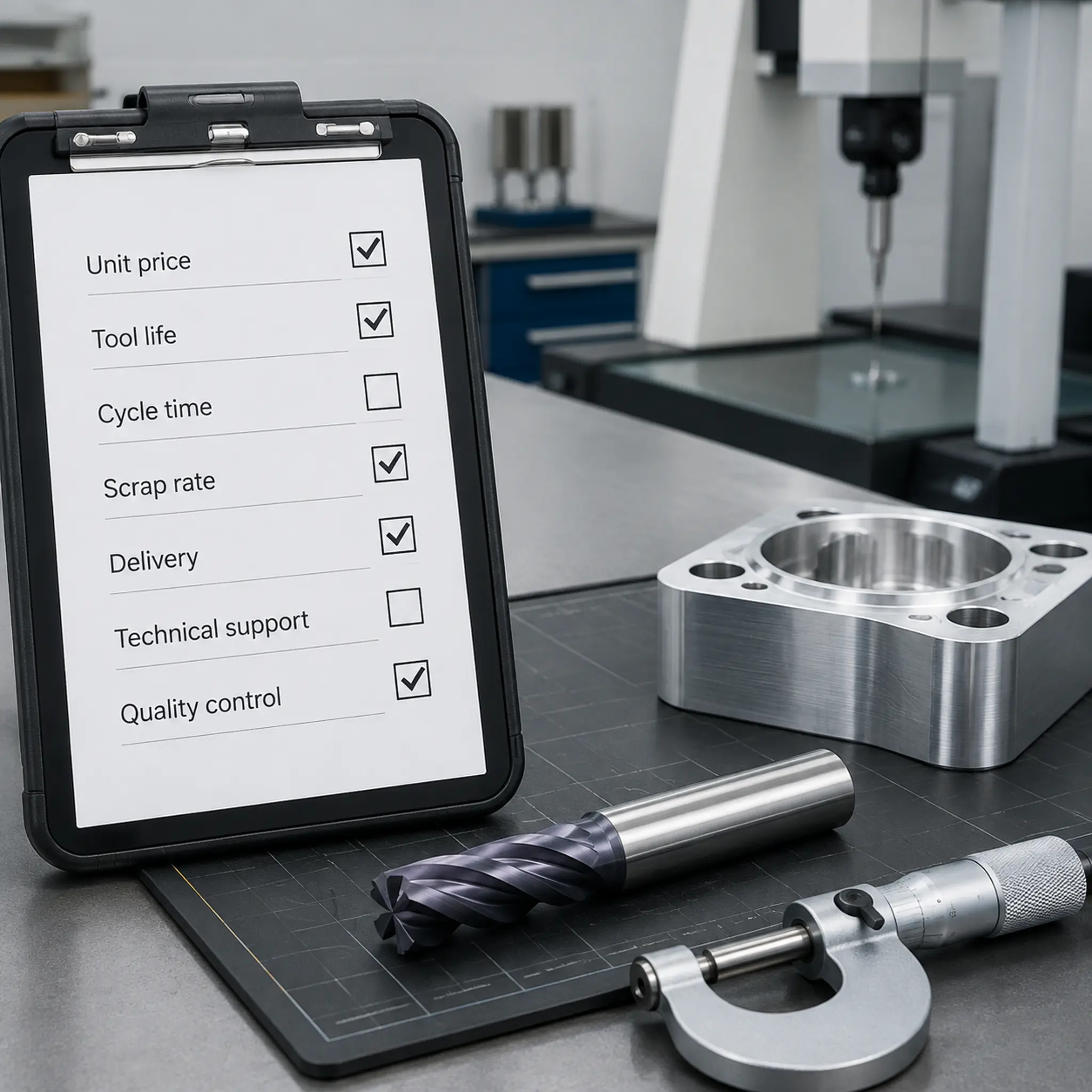
A practical procurement scorecard should include both commercial and technical data.
Evaluation Area | What to Check | Why It Matters |
|---|---|---|
Unit price | Quoted tool cost | Needed for budget control |
Tool life | Parts per cutter | Shows durability and cost-per-part |
Cycle time | Seconds per part | Impacts capacity and machine cost |
Scrap rate | Defective or reworked parts | Measures quality stability |
Delivery | Lead time and consistency | Protects production planning |
Technical support | Cutting data and troubleshooting | Reduces trial risk |
Quality control | Inspection reports and process controls | Supports repeatability |
This table prevents the lowest quote from winning automatically. It also prevents technical teams from approving expensive tools without business evidence.
Step 3: Check manufacturing and quality control capability
For industrial buyers, supplier capability matters because end mills must be repeatable. A good first batch is not enough. The supplier must hold geometry, diameter tolerance, coating consistency, and edge quality across repeat orders.
At QT TOOLS, our business context is built around carbide end mills, woodworking tools, production equipment, testing instruments, R&D support, and QC teams. I still encourage buyers to verify supplier claims through documents, samples, inspection reports, and trial results. Certifications and quality documents should be treated as materials to review, not as substitutes for production testing.
Buyers can ask suppliers for:
- Tool drawings or specification sheets
- Material and carbide grade information where available
- Coating information and intended application range
- Inspection data for diameter, runout, and flute geometry
- Packaging and batch identification method
- Recommended cutting parameters
- Trial support process
Step 4: Control the trial conditions
A tooling trial should not be casual. A poorly controlled trial can reject a good tool or approve a tool for the wrong reason.
I recommend controlling:
- Machine condition Spindle condition, rigidity, and power must be suitable.
- Toolholder runout Excessive runout can destroy tool life, especially on small diameters.[11]
- Coolant condition Concentration, pressure, and direction should be recorded.
- Workpiece batch Material variation can affect cutting performance.
- Cutting parameters Speed, feed, axial depth, and radial depth must be documented.
- Inspection method The same quality standard should apply to both tools.
Step 5: Decide based on cost-per-part and risk
After the trial, the decision should return to the numbers. I like to calculate:
- Tool cost per part
- Machine cost per part
- Tool-change labor impact
- Scrap and rework cost
- Output per shift
- Risk of sudden failure
- Delivery and supply reliability
This approach is especially useful for factories in automotive, aerospace, medical, mold, and general precision manufacturing. These factories usually care about stable output as much as they care about price.
A premium cutter may not be justified in every job. For soft materials, low-volume work, or non-critical operations, a standard tool may be enough. However, when the operation involves difficult materials, tight quality requirements, and high monthly volume, the premium option deserves a controlled test.
Frequently Asked Questions
Are high-performance solid carbide end mills always better than standard carbide tools?
No. High-performance tools are most valuable in demanding applications, such as stainless steel, titanium, hardened steel, or high-volume production. For simple, low-volume, or low-risk machining, a standard carbide tool may be sufficient. I recommend comparing tools through a controlled cost-per-part trial.
How should I calculate cost-per-part for an end mill?
You should include tool price, tool life, cycle time, machine hourly cost, tool-change downtime, scrap rate, and rework cost. Tool cost alone can be misleading. In mass production, a small cycle time reduction may save more money than the full purchase price of the cutter.
What information should I send to a supplier before requesting a quotation?
You should send material grade, hardness, operation type, tool diameter, flute length, machine type, holder type, coolant method, current cutting parameters, tool life target, and quality issues. Better application data helps the supplier recommend a tool that fits the process.
Can a premium end mill fix chatter problems by itself?
Sometimes it helps, but it is not guaranteed. Chatter can come from tool geometry, toolholder runout, weak fixturing, long overhang, poor parameters, or machine condition.[12] A better end mill can reduce vibration, but the full machining system should be reviewed.
How long should a tooling trial run?
A trial should run long enough to measure full tool life and quality stability. One short cut is not enough. For high-volume production, I prefer testing across multiple tool lives under controlled conditions, then comparing cycle time, wear pattern, scrap, and operator intervention.
Conclusion
High-Performance Solid Carbide End Mills should be evaluated as a business decision, not only a tooling purchase. The right cutter can reduce total cost of ownership through longer tool life, faster cycle time, lower scrap, and better machine uptime. The best way to justify the investment is a controlled production trial with clear metrics. If your team is machining difficult materials or trying to reduce cost-per-part, contact QT TOOLS to discuss your application and plan a practical tool evaluation.
1
"Costs and Cost Effectiveness of Additive Manufacturing", https://nvlpubs.nist.gov/nistpubs/specialpublications/nist.sp.1176.pdf. Manufacturing cost models commonly treat tooling as one component of total production cost, alongside machine time, labor, downtime, and quality-related losses, supporting a total-cost rather than unit-price basis for tool selection. Evidence role: general_support; source type: paper. Supports: A manufacturing economics source should support evaluating machining decisions by total production cost, including tooling, machine time, downtime, and quality losses rather than purchase price alone.. Scope note: This supports the evaluation framework generally, not the specific performance of any named end mill.
2
"Cost and Process Information Modeling for Dry Machining", https://tsapps.nist.gov/publication/get_pdf.cfm?pub_id=821121. Machining cost models that multiply cycle time by a machine-hour rate show why reductions in machine time can outweigh differences in cutting-tool purchase cost in high-volume production. Evidence role: general_support; source type: government. Supports: A government or standards-based manufacturing cost model should show that machining cost calculations include machine-hour rate and cycle time, which can dominate per-part cost in production.. Scope note: The source would support the cost mechanism; the relative importance varies by shop rate, cycle time, and production volume.
3
"Chatter Stability of Machining Operations", https://mtrc.utk.edu/wp-content/uploads/sites/45/2020/08/manu_142_11_110801.pdf. Research on milling dynamics reports that variable-pitch or variable-helix cutter designs can alter tooth passing intervals and reduce regenerative chatter under suitable cutting conditions. Evidence role: mechanism; source type: paper. Supports: A peer-reviewed machining dynamics paper should support that variable pitch or variable helix cutters can disrupt regenerative chatter and improve milling stability.. Scope note: The support is mechanism-based; actual chatter reduction depends on machine dynamics, tool overhang, workholding, and cutting parameters.
4
"design and optimization of end mills with special geometries for high ...", https://research.sabanciuniv.edu/42529/1/10420484.pdf. Studies of milling tool geometry indicate that flute design influences chip flow and evacuation, which can affect cutting temperature, recutting, and process stability. Evidence role: mechanism; source type: paper. Supports: A machining research source should explain that flute geometry affects chip formation, chip flow, and evacuation from the cutting zone.. Scope note: This supports the general relationship between flute geometry and chip evacuation, not a specific flute design or brand.
5
"Cutting conditions and tool wear when machining wood-based materials", https://bioresources.cnr.ncsu.edu/resources/cutting-conditions-and-tool-wear-when-machining-wood-based-materials/. Cutting-tool research shows that edge preparation modifies edge strength and wear behavior, and can reduce premature chipping when matched to the work material and cutting conditions. Evidence role: mechanism; source type: paper. Supports: A peer-reviewed cutting-tool study should support that controlled cutting-edge preparation affects edge strength, micro-chipping, wear progression, and tool life.. Scope note: The effect can be positive or negative depending on edge radius, coating, workpiece material, and cutting parameters.
6
"PERFORMANCE OF COATED CUTTING TOOLS IN MACHINING", http://conferences.sta.uwi.edu/iconetech2020/documents/RSRevuru-PERFORMANCEOFCOATEDCUTTINGTOOLSINMACHINING.pdf. Research on coated carbide cutting tools reports that suitable hard coatings can improve wear and thermal resistance, enabling higher cutting speeds or longer tool life in compatible applications. Evidence role: mechanism; source type: paper. Supports: A review or research paper should support that hard coatings on carbide tools can improve wear resistance, oxidation resistance, and thermal performance in machining.. Scope note: This is contextual support; coating performance depends strongly on coating type, substrate, work material, coolant, and cutting conditions.
7
"Stainless steel", https://en.wikipedia.org/wiki/Stainless_steel. Materials and machining references describe austenitic stainless steels as prone to work hardening during machining, particularly when cutting conditions promote rubbing rather than shearing. Evidence role: mechanism; source type: education. Supports: A university or technical materials source should support that austenitic stainless steels have significant work-hardening tendencies and that poor cutting action can worsen machining difficulty.. Scope note: The claim applies most directly to austenitic grades such as 304 and 316; behavior differs among stainless-steel families and heat treatments.
8
"Machining Simulation of Ti-6Al-4V Alloy Using Finite Element ...", https://ui.adsabs.harvard.edu/abs/2019icev.conf...13I/abstract. Machining studies of titanium alloys identify low thermal conductivity as a reason heat remains concentrated near the tool-chip interface, increasing thermal stress on the cutting edge. Evidence role: mechanism; source type: paper. Supports: A machining or materials paper should support that titanium alloys have low thermal conductivity and tend to concentrate heat near the cutting tool during machining.. Scope note: This supports a common mechanism in titanium machining; exact heat distribution depends on alloy, speed, feed, coolant, and tool geometry.
9
"A New Cutting Tool Design for Cryogenic Machining of Ti–6Al ...", https://pmc.ncbi.nlm.nih.gov/articles/PMC6385146/. Reviews of titanium alloy machining report adhesion-related built-up edge, notch wear, and rapid tool degradation as recurring wear mechanisms under unfavorable tool and cutting conditions. Evidence role: mechanism; source type: paper. Supports: A titanium-machining review should support that notch wear, adhesion or built-up edge, and rapid tool degradation are common tool-wear problems when machining titanium alloys.. Scope note: The source would support the general failure modes, not prove that any specific premium cutter prevents them.
10
"Investigation of Tool Wear and Chip Morphology in Dry ... - PMC", https://pmc.ncbi.nlm.nih.gov/articles/PMC6630620/. Machining research on trochoidal and high-efficiency milling indicates that controlled radial engagement can reduce cutting forces, temperature, or tool wear compared with conventional slotting in suitable applications. Evidence role: mechanism; source type: paper. Supports: A machining research paper should support that trochoidal or high-efficiency milling can reduce cutting forces, temperature, or tool wear by controlling radial engagement and chip load.. Scope note: The evidence is process-specific; benefits depend on toolpath parameters, machine capability, coolant strategy, and workpiece geometry.
11
"Study on In-Situ Tool Wear Detection during Micro End Milling Based on ...", https://pmc.ncbi.nlm.nih.gov/articles/PMC9860921/. Milling studies show that tool runout produces uneven tooth loading and can accelerate wear or failure, making runout control especially important for small-diameter cutters. Evidence role: mechanism; source type: paper. Supports: A milling research source should support that cutter runout creates unequal tooth loading, increasing wear and reducing tool life, with greater sensitivity for smaller tools.. Scope note: The magnitude of tool-life reduction depends on runout level, tool diameter, number of flutes, material, and cutting parameters.
12
"(PDF) Chatter in machining processes: A review", https://www.academia.edu/30406297/Chatter_in_machining_processes_A_review. Machining dynamics literature characterizes chatter as a self-excited vibration governed by the combined machine-tool-workpiece system, including structural stiffness, tool geometry, overhang, workholding, runout, and cutting parameters. Evidence role: expert_consensus; source type: paper. Supports: A machining dynamics review should support that chatter is a system-level instability influenced by machine-tool dynamics, tool geometry, workholding, tool overhang, and cutting parameters.. Scope note: This supports the diagnostic framework generally; identifying the dominant cause in a specific shop requires measurement or controlled testing.